Today, every marketing automation platform ships with “AI” as part of its core offering, making this term more or less useful to marketers looking for AI capabilities in whatever field of endeavour they are engaged in.
Therefore, the question going forward, especially by 2030, will not be whether any of the above-named solutions will have any kind of A.I. capability.
All three do. The question is what kind of AI is embedded, what it depends on, and what it actually changes in day-to-day operations.
Some AI features help teams move faster. Others quietly introduce cost, risk, or reporting confusion.
In this comparison guide, we’ll look into each platform to separate assistive AI from decisioning AI and explain where each platform delivers value—or friction—based on company stage and stack maturity.
How Does “AI” Work in Marketing Automation?
Most AI inside marketing automation tools falls into three buckets:
- AI for creation: Writing subject lines, emails, summaries, or suggestions. These features save time but do not change outcomes on their own.
- AI for decisioning: Choosing send times, predicting engagement, identifying fatigue, or scoring leads. These features influence revenue when the underlying data is clean and accurate.
- AI for execution: Agents or automated actions that trigger workflows, update records, or route activity without manual input.
Problems start when teams assume these categories are interchangeable. They are not. Decisioning AI fails without stable lifecycle definitions. Execution AI amplifies mistakes if systems of record are unclear or inconsistent.
That context matters when evaluating each platform.
HubSpot Breeze, Eloqua Advanced Intelligence & ActiveCampaign AI Statistics 2026
HubSpot Breeze Statistics 2026
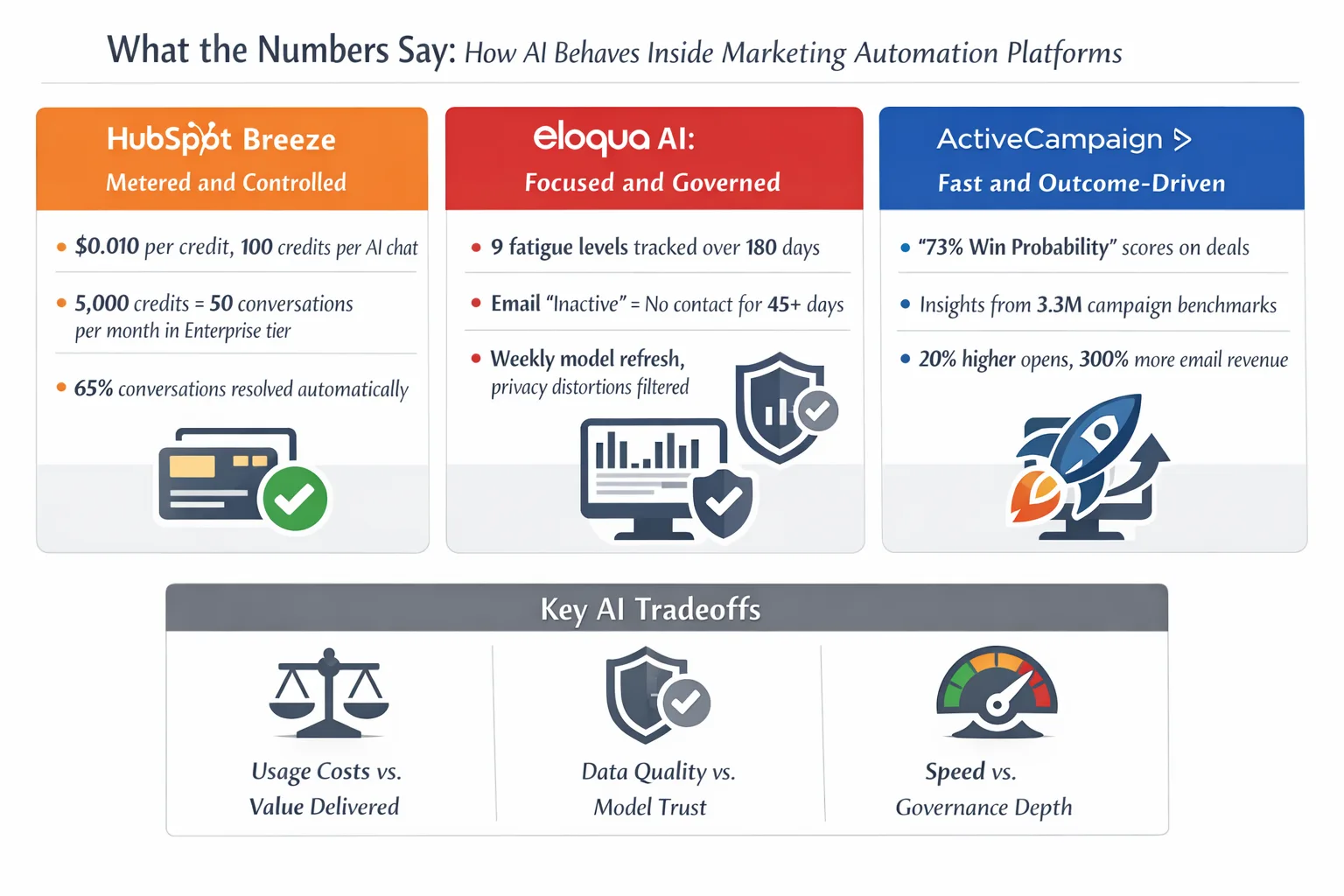
- Breeze Customer Agent costs 100 HubSpot Credits per conversation (text-based channels). (HubSpot Marketplace listing)
- HubSpot’s own marketplace page claims Customer Agent can resolve 65% of conversations 24/7. (HubSpot Marketplace listing)
- HubSpot’s Product & Services Catalog lists $0.010 per Pay-as-You-Go credit for overages. (HubSpot legal catalog)
- Pay-as-You-Go credit purchases are invoiced in increments of 10 credits. (HubSpot legal catalog)
- HubSpot’s community post states included monthly credits by tier: Starter 500, Professional 3,000, and Enterprise 5,000. (HubSpot Community – Breeze Library)
- HubSpot confirms credits reset monthly and do not roll over (unused credits expire). (HubSpot Knowledge Base)
- HubSpot’s Breeze Data Agent shows ~19K installs in the marketplace experience. (HubSpot Marketplace)
- HubSpot’s Breeze Company Research Agent shows ~6K installs in the marketplace experience. (HubSpot Marketplace)
- A HubSpot community AMA thread references the same economics: 100 credits per Customer Agent conversation, and 5,000 credits ≈ for 50 conversations at that rate. (HubSpot Community AMA)
Eloqua Advanced Intelligence Statistics 2026
- Oracle states that effective June 12, 2025, Eloqua’s Advanced Intelligence (AI) features are available for all customers (activation still requires a service request). (Oracle Eloqua docs)
- Eloqua Fatigue Analysis assigns 9 possible fatigue classifications (from Inactive through Oversaturated-high). (Oracle Eloqua docs)
- Eloqua defines “Inactive” as a contact that has not received an email in the last 45 days, or is new with no engagement history. (Oracle Eloqua docs)
- Fatigue Level calculation uses sends + opens across the last 180 days (6 months). (Oracle Eloqua docs)
- Oracle recommends at least 180 days (6 months) of consistent send volume for the best Fatigue Analysis results after first enablement. (Oracle Eloqua docs)
- The fatigue model is refreshed every week. (Oracle Eloqua docs)
- Oracle explicitly calls out measurement distortion sources it tracks separately, including Apple Mail Privacy auto-opens and other email scanning tools.(Oracle Eloqua docs)
ActiveCampaign AI Statistics 2026
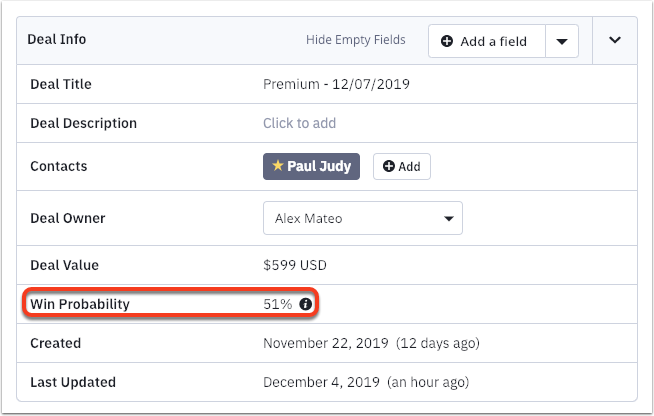
- ActiveCampaign’s Win Probability produces an exact percentage for each deal (example shown as “73% likely to close”). (ActiveCampaign)
- ActiveCampaign defines Win Probability as a percentage field on each deal used to prioritize sales effort. (ActiveCampaign help center)
- ActiveCampaign’s AI content tool in the Email Designer generates three text options from a single prompt. (ActiveCampaign help center)
- ActiveCampaign published research stating that 82% of respondents say their businesses use AI for marketing activities. (ActiveCampaign blog)
- In the same dataset, marketers are reported to be 2.5x more likely to say they use AI for marketing than for other business areas listed. (ActiveCampaign blog)
- ActiveCampaign cites benchmark data sampled from 3.3M email campaigns, with a “good” open rate around 42.35%. (ActiveCampaign benchmarks glossary)
- ActiveCampaign’s own guidance warns that Apple Mail Privacy Protection can report 100% open rates for contacts with MPP enabled. (ActiveCampaign help center)
- ActiveCampaign’s guidance on B2B timing states that emails sent before 8 AM can achieve open rates of 20%-35% (as a timing benchmark). (ActiveCampaign blog)
- ActiveCampaign’s AI page includes a customer story where predictive sending boosted open rates by 20% and increased month-to-month email revenue by 300%. (ActiveCampaign AI)
HubSpot Breeze in 2026: Broad AI Coverage, Strong Context, Real Governance Tradeoffs
Source: HubSpot
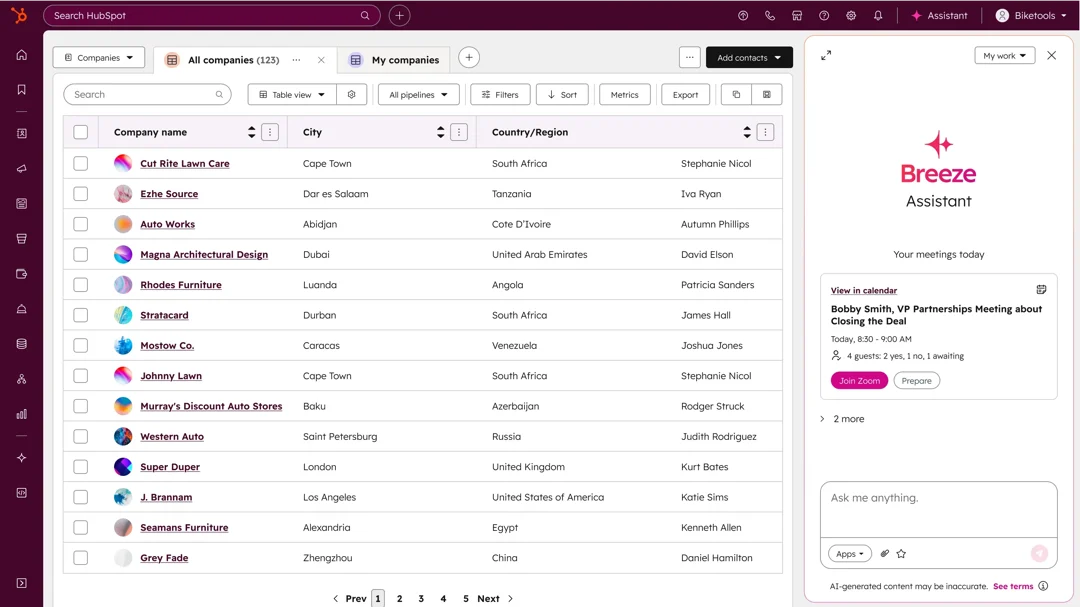
HubSpot’s AI layer, branded as Breeze, is designed to span the entire platform rather than sit within a single feature.
Breeze includes assistants, agents, and intelligence that draw from HubSpot CRM data, marketing activity, and user-defined context. Configuration is done in Breeze Studio, where teams define what AI can access and how it behaves.
Where HubSpot Breeze Works Best

Source: HubSpot
If customers have high-quality CRM and customer lifecycle data, the HubSpot Breeze solution has achieved the highest level of effectiveness.
Since HubSpot is commonly both a CRM solution and a marketing automation platform, especially within SMBs and mid-market, it will have abundant relevant data to draw from.
Common strengths include:
- Drafting and refining emails, landing pages, and summaries with awareness of contacts and deals
- Assisting sales and service teams using shared CRM context
- Supporting cross-team workflows without leaving the HubSpot interface
Consequently, this, combined with Breeze, will prove effective for marketing teams who desire speed and continuous consistency in a marketing automation application.
Cost and Usage Economics of HubSpot Breeze
HubSpot positions Breeze as a platform-wide AI layer rather than a single feature—the economics behind that decision matter.
The use of HubSpot Breeze is restricted by a Credit-Based Usage Model, which deducts 100 Credits for each Customer Agent Interaction with a user.
For each agency at the highest expense tier (i.e., Enterprise), there is an allocation of 5000 credits/month, which equates to around 50 AI-driven customer-agent interactions per month without incurring an overall credit expense.
All Credits are reset monthly, with no credits rolling over month to month, so customers using Breeze must monitor their credit usage and when credits will be replenished to take advantage of the AI tool’s capabilities.
This model creates two practical outcomes.
First, Breeze usage becomes intentional. Teams choose where AI delivers the most value, rather than enabling it everywhere. Second, AI adoption introduces a new operational metric: credit consumption per workflow.
In addition, HubSpot has stated that 65% of all customer-agent interactions can be processed automatically, making the cost of using HubSpot Breeze justifiable in a high-volume service environment, given its functionality.
Substantial evidence of total installed customers for Breeze exists, with many of the individual Breeze agents currently installed in thousands of locations, indicating that it is functioning and not just for experimental use.
The key takeaway is that Breeze is not “free AI.” It is metered AI, best suited for teams with clean CRM data and enough operational discipline to track usage and ROI.
Where teams need to be careful
Breeze introduces governance questions earlier than many teams expect. AI usage is often tied to credits or tiered access, which requires monitoring as usage scales. More importantly, Breeze inherits the CRM’s lifecycle and field logic.
If lifecycle stages are inconsistent or overwritten by multiple integrations, Breeze does not correct that. It works faster on top of it.
HubSpot Breeze works best when:
- HubSpot is the primary system of record.
- Lifecycle stages are enforced.
- Integrations are stable and documented.
Eloqua Advanced Intelligence in 2026: Narrow Scope, High Signal, Enterprise Discipline
Source: Oracle
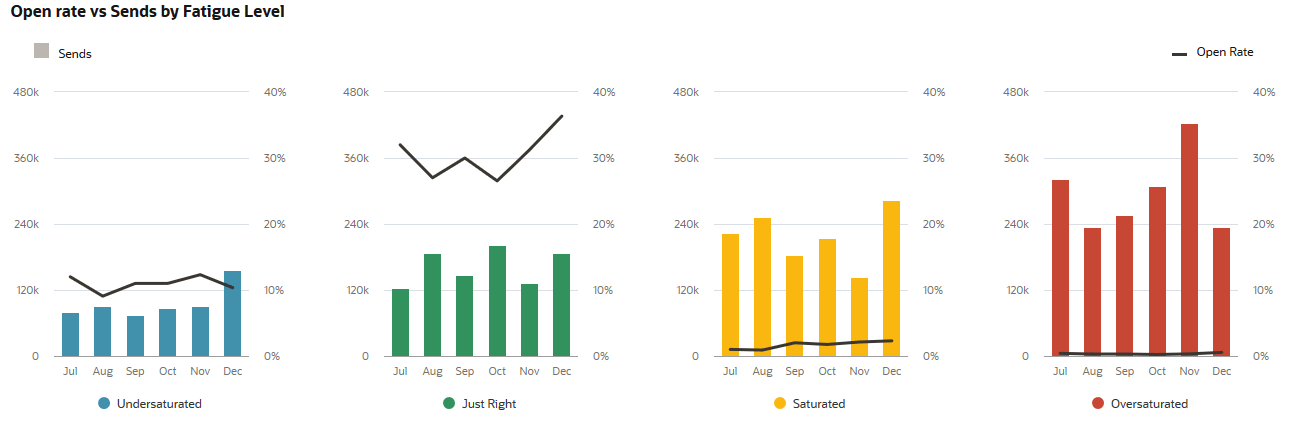
Oracle Eloqua Advanced Intelligence takes a very different approach. It is not designed to assist broadly across content and workflows. It is designed to optimize specific high-impact decisions, primarily around email and account engagement.
Advanced Intelligence focuses on:
- Email fatigue detection
- Optimal send time
- Subject line performance
- Account-level engagement signals
Where Eloqua’s AI stands out
Source: Oracle
Eloqua’s AI is built for controlled enterprise environments. It assumes that CRM ownership is external, that data models are strict, and that processes are enforced.
In those conditions, Eloqua’s intelligence delivers a strong signal quality. Fatigue detection and send-time optimization reduce over-messaging in long sales cycles. Account engagement metrics support buying group analysis rather than individual behavior.
This makes Advanced Intelligence well-suited for:
- Large databases
- Regulated industries
- Multi-stakeholder sales cycles
- Teams prioritizing risk control over speed
Source: Oracle
Models, mechanics, and Governance of Advanced Intelligence from Eloqua
Oracle Eloqua takes the opposite approach. Its Advanced Intelligence features are not priced per interaction and are not designed to assist broadly across workflows. Instead, they focus on specific, high-impact decisions, especially in email engagement.
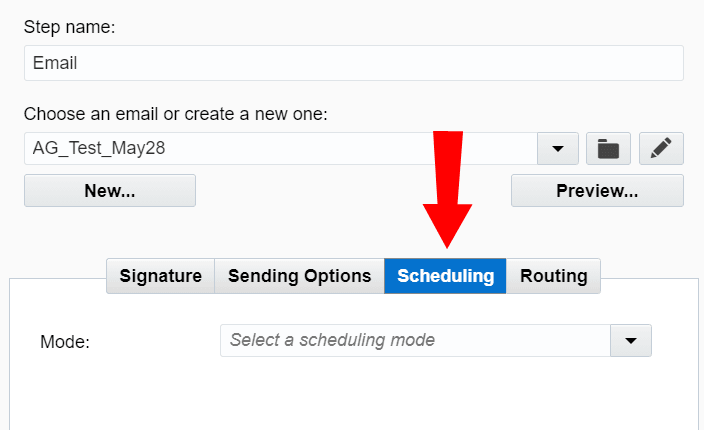
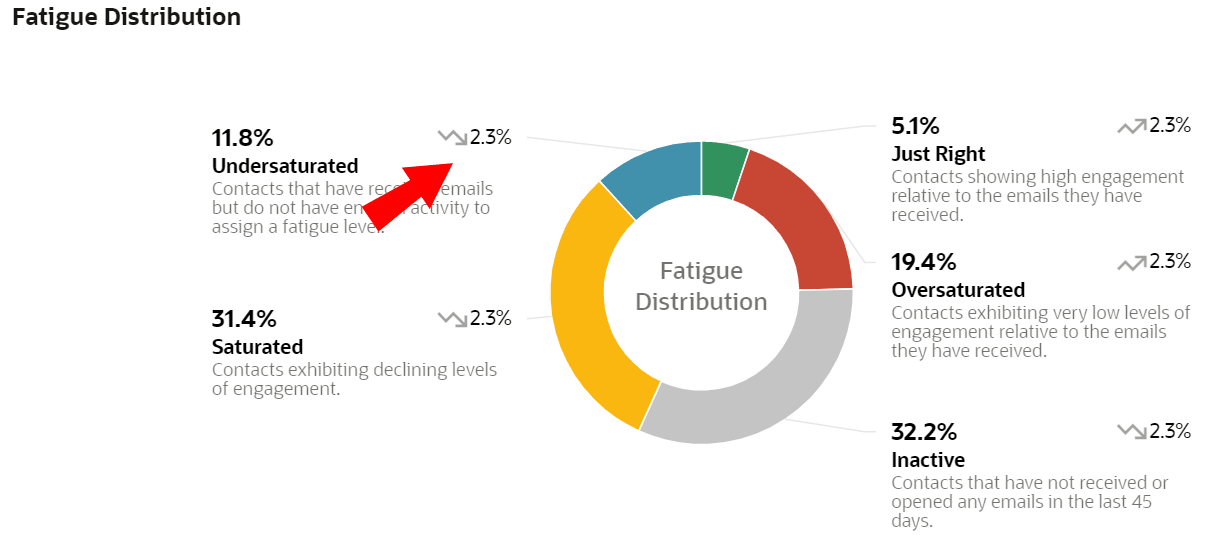
Eloqua’s Fatigue Analysis model classifies contacts into nine distinct fatigue levels, using engagement and send data from the previous 180 days.
Contacts are marked “Inactive” if they have not received an email in 45 days, and the model refreshes weekly.
According to Oracle, teams should establish at least 6 months of consistent email activity before relying on predictions generated by the Eloqua Advanced Intelligence Model (as noted in the Oracle Eloqua documentation).
The uniqueness of this model is less a function of its sophistication than of restraint. Eloqua explicitly includes associated distortions, such as Apple Mail’s privacy protection auto-opens, to facilitate the identification of signal from noise rather than hiding them.
This is a characteristic inherent to Eloqua’s Enterprise Design philosophy, which seeks to offer AI functionality based on fewer but more certain guarantees of interpretability and control.
In addition, Oracle has officially stated that advanced intelligence will be made generally available to all customers in mid-2025. This indicates Oracle’s confidence that the product has been sufficiently matured through testing and will no longer be a part of its experimental catalog of add-on applications.
For enterprise teams, these mechanics matter more than headline features. Eloqua’s AI works best where governance, auditability, and repeatability are non-negotiable.
What Eloqua does not try to do
Eloqua does not attempt to be a creative assistant or agentic platform. It does not draft content or act autonomously across workflows. Its AI stays close to defined use cases.
That restraint is a feature, not a limitation, for organizations that value predictability and auditability.
ActiveCampaign AI in 2026: Fast Decisioning for SMB and Growth Teams
ActiveCampaign’s AI capabilities focus on helping small and growth-stage teams act quickly.
Key features include:
- Predictive sending
- Win probability
- Predictive lead scoring
- AI-assisted automation building
Where ActiveCampaign AI delivers value
Source: ActiveCampaign
ActiveCampaign AI works best in high-velocity environments where teams need guidance but cannot support heavy governance.
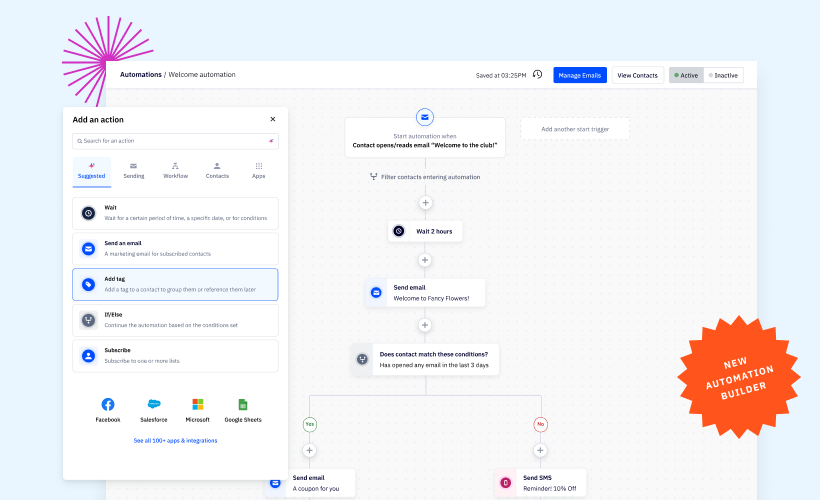
Predictive sending and scoring help prioritize outreach when data volumes are moderate, and lifecycle logic is simple. AI-assisted builders reduce setup time for teams without dedicated operations staff.
For SMB and early mid-market organizations, this often delivers immediate gains.
Source: ActiveCampaign
ActiveCampaign AI Outcome Signals and Benchmarks
ActiveCampaign frames AI primarily around outcomes—especially speed, prioritization, and revenue impact.
Its Win Probability feature assigns a percentage likelihood to each deal, commonly shown as values like “73% likely to close”, helping sales teams prioritize effort. Predictive Sending and Predictive Lead Scoring further guide when and where outreach should occur (ActiveCampaign product and help documentation).
ActiveCampaign backs this positioning with volume-based benchmarks. The company reports that its email benchmarks are derived from over 3.3 million campaigns, with a “good” open rate averaging 42.35%.
However, ActiveCampaign has also acknowledged the challenges of measurement in modern-day attribution. For instance, the Apple Mail privacy protection problem can cause significant distortion in accurately measuring open rates, potentially inflating the open rates of certain contacts to as much as 100% (as noted in the ActiveCampaign Help Centre).
According to ActiveCampaign research, 82% of companies currently use AI for at least some aspect of their marketing program. They have also provided numerous customer success stories that showcase the predictive capabilities, which have led to open rates averaging 20% higher than the previous month and increased monthly email revenue by 300% (as noted on the ActiveCampaign blog and AI platform pages).
The pattern is clear. ActiveCampaign AI is designed to move fast and show a visible lift, particularly in SMB and growth-stage environments. Governance and deep attribution come later, often outside the platform.
Where the ceiling appears
As stacks become more complex, ActiveCampaign AI relies increasingly on external systems for reporting and governance. Attribution depth, multi-object analysis, and cross-BU control are limited.
ActiveCampaign AI excels at helping teams move faster. It is less suited to environments where AI outputs must be tightly audited or reconciled across multiple systems.
Capability Matrix: AI Inside Each Platform (2026)
| Capability Area | HubSpot Breeze | Eloqua Advanced Intelligence | ActiveCampaign AI |
| AI for content creation | Strong | Limited | Moderate |
| AI for decisioning | Moderate–Strong | Strong | Moderate |
| AI for execution/agents | Emerging | Limited | Limited |
| CRM & lifecycle dependency | High | High | Medium |
| Governance & auditability | Medium | High | Low–Medium |
| Account-level intelligence | Moderate | Strong | Limited |
| Integration tolerance | High (when governed) | High | Moderate |
| Best fit by stage | SMB → Mid-market | Enterprise | SMB → Growth |
How The Automation Strategy Group Can Help
The Automation Strategy Group works with teams that already have marketing automation platforms in place but are struggling with the complexity introduced by integrations, lifecycle sprawl, or AI features layered too early.
The work typically starts by clarifying systems of record and stabilizing data flows. Only then does AI become useful.
The Automation Strategy Group offers organizations guidance on the effective use of AI within their HubSpot, ActiveCampaign, and Eloqua environments.
For more information, schedule a consultation with one of our automation experts.
Final Verdict
For Artificial Intelligence to be widely adopted by 2026, it must be an integral component of all marketing automation solutions. The difference between successful integration will be determined by the extent to which AI can be constrained, contextualized, and governed.
HubSpot’s Breeze is most effective when used with clean CRM data and within organizations seeking to incorporate AI into their core business process workflows.
Eloqua Advanced Intelligence delivers the greatest value to users when signal quality and control are more critical than the speed at which signals arrive.
ActiveCampaign AI provides efficient guidance to fast-paced teams with limited resources.
Success for the marketing automation teams will come from enabling AI features rather than using it only when necessary, and from determining which AI is credible and how to leverage those capabilities effectively.