
The growth of digital advertising has necessitated the combined use of both strategy and technology. Marketing Automation solutions are not merely an isolated technology, but rather an integral part of a much larger technology ecosystem that drives ongoing lead growth through lead nurturing pipelines, as well as providing sales and marketing with a means to jointly monitor their performance.
Understanding how to use these platforms successfully requires understanding how they function (what they do) and how they compare to other solutions in the stacks used in small, medium, and enterprise organizations.
This analysis maps the companion technologies that commonly coexist with HubSpot, Oracle Eloqua, and ActiveCampaign, using publicly available technology usage data and practical patterns observed in modern marketing operations.
The goal of this guide is to provide an evidence-based view of how stacks evolve across business stages and why specific tool combinations emerge in real practice.
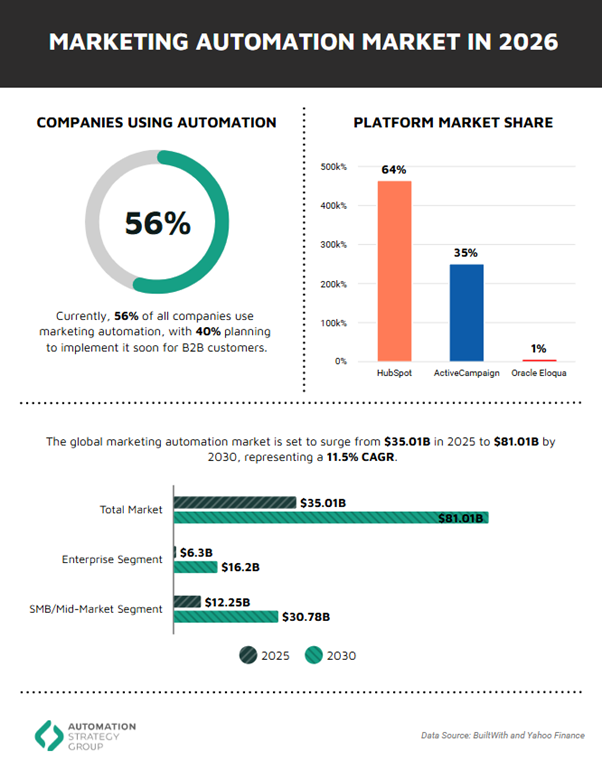
The Marketing Automation Market in 2026
BuiltWith’s Marketing Automation Analytics and Tracking category shows not only a range of vendors but also serves as a proxy for understanding where different platforms sit in the broader adoption landscape.
Among the tools detected across the web:
- Klaviyo leads in usage, followed by HubSpot and Brevo. ActiveCampaign also appears within the top 10.
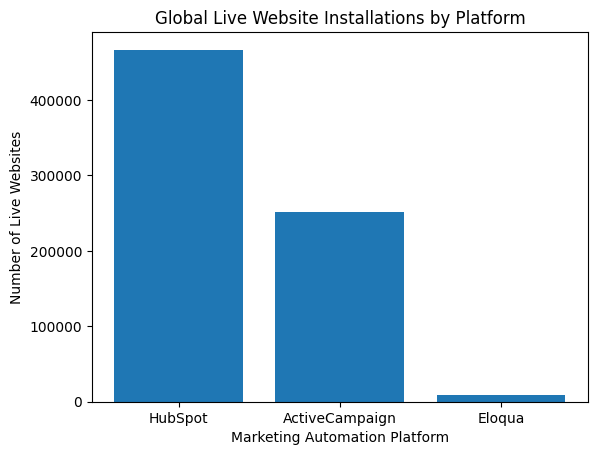
In the United States specifically, the distribution of installs shows a similar pattern where:
- HighLevel, Brevo, Klaviyo, and MailerLite have larger footprints.
- HubSpot appears on over 221,000 sites.
- ActiveCampaign appears on 85,580 sites.
These distributions illustrate patterns relevant to business segmentation: SMB-oriented tools tend to have higher absolute usage counts, while enterprise solutions often show lower penetration through web detection alone due to differing technical implementations.
Marketing Automation Adoption and Usage in 2026
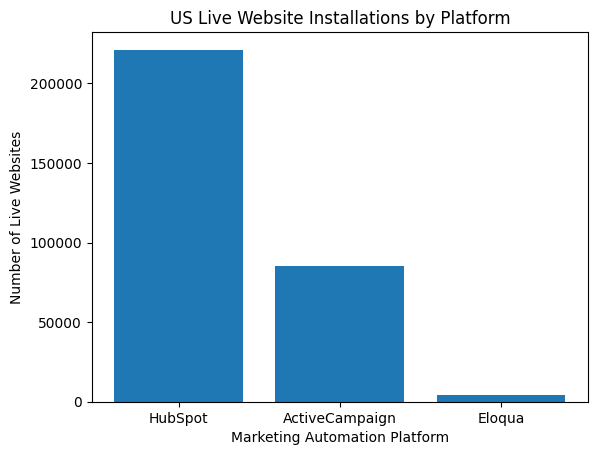
1. HubSpot is currently associated with 466,709 websites across the globe that are live and using the HubSpot marketing automation platform. – BuiltWith
2. HubSpot accounts for 221,175 of those sites that are in the United States, indicating that the company has an established presence in the North American market. – BuiltWith
3. ActiveCampaign is found on 251,991 total live websites around the world, indicating that it has carved out a large share of the small to mid-size business (SMB) and mid-market customer base. – BuiltWith
4. ActiveCampaign has 85,580 total installations in the U.S. market and further illustrates how important SMBs are in its overall strategy. – BuiltWith
5. Oracle Eloqua has 8,545 live installations in the world, indicating that it serves a niche area of marketing automation for enterprise customers. – BuiltWith
6. Eloqua accounts for 4,356 total installations in the U.S. market and demonstrates how important Eloqua is in the enterprise space. – BuiltWith
7. 56% overall of all companies are using some form of marketing automation today, and 40% plan to implement automation in short order for B2B corporate customers. – – EmailMonday
8. In 2024, the global marketing automation industry is estimated at USD 6.65 billion and projected to expand at an annualized rate of 15.3% to USD 15.58 billion by 2030. – Grand View Research
9. On a global level, overall and over the opportunity for marketing automation, the total market for marketing automation is expected to grow to USD 81.01 billion by 2030, up from USD 35.01 billion in 2025, with a compound annual growth rate (CAGR) of 11.5% from 2025 through 2030. – Yahoo Finance
10. Looking at the overall industry revenue growth trend for the global marketing automation market, from 2021 to 2024, the marketing automation industry will grow at 38.2% CAGR for a forecasted 2021-2024 industry revenue of USD 6.62 billion. –Backlinko
11. The marketing automation software sector was led by HubSpot with an estimated market share of approximately 38.27%, along with Adobe Experience Cloud and Oracle Marketing Cloud toolsets. – Backlinko
12. There are at least 398 separate marketing automation software solutions in the market as of 2024, giving you numerous options. – Backlinko
13. Of marketers surveyed, 56% of companies used automation to increase the efficiency of their marketing processes. – HubSpot
14. Approximately 93% of marketers have utilized automation for task scheduling, tracking, and reporting. – HubSpot
15. An overwhelming majority of marketers, 92% and upwards, report using automation to analyze data and prepare reports. Thus, an important factor for performance measurement is automation. – HubSpot
16. Adoption of automation and improvement of marketing efficiency is reported by 47% of marketers, indicating widespread application for practical purposes. – HubSpot
17. Additionally, larger organizations that are more successful in B2B organizations demonstrated significantly higher use of marketing automation, with 72% of successful organizations using automation, relative to only 18% of unsuccessful organizations. – Colorlib
18. HubSpot, Brevo, and ActiveCampaign were predominant technologies detected as providing available solutions in multiple countries, including Switzerland, as well as globally across multiple countries. – BuiltWith
19. North America is estimated to lead the marketing automation software market with approximately 43.6% of revenue in 2024, by far the largest region with the highest contribution to the total. – Grand View Research
20. A significant part (approximately 74%) of the marketing automation market is moving towards the cloud, which correlates with the increasing popularity of cloud-based solutions versus traditional on-premise systems (by 72%+). – MarketsandMarkets
Business Stage Segmentation
Stacks are segmented into three broad stages:
- SMB (Small and Emerging Companies): Focus on simplicity, rapid deployment, integrated tools that cover multiple functions, and minimal custom infrastructure.
- Mid-Market (Growth-Stage Organizations): Increasing specialization of tools as volumes grow, more focus on data quality, analytics, and cross-department alignment.
- Enterprise (Large Organizations): Sophisticated ecosystems with multiple systems of record, governance requirements, and separate layers for identity management and data warehousing.
2026 Stack Maps by Business Stage
The section below provides an overview of typical technology stacks that include the three main marketing automation tools: HubSpot, ActiveCampaign, and Eloqua.
Each group of stacks details how organizations are building extended functional capabilities around their core marketing automation platforms (i.e., acquisition, engagement, data enrichment, analytics, operations) at various stages of their company development.
HubSpot Tech Stacks for SMBs
In most SMBs, HubSpot is utilized as a core technology stack for both CRM and Marketing Automation. In SMBs, there will be applications that support basic digital operations. Some common examples of digital operations would be:
- Website/CMS: WordPress, Custom CMS
- Email Deliverability: Integrations that provide improved email deliverability and personalization
- Scheduling: Calendly, Appointment Schedulers, Event Schedulers
- Basic Analytics and Attributions: Website Performance, Channel Attribution via Google
- Lead Capture: Forms & pop-ups that pull leads into HubSpot CRM
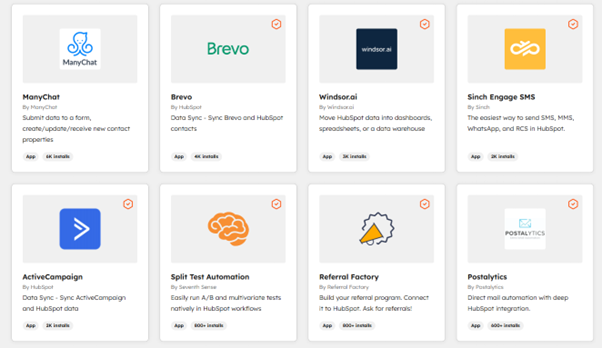
There are currently over 100 marketing automation integrations in the HubSpot Marketplace that expand on the basic HubSpot functionality, demonstrating the platform’s flexibility for smaller organizations.
Screenshot: HubSpot
HubSpot Tech Stacks for Mid-Market
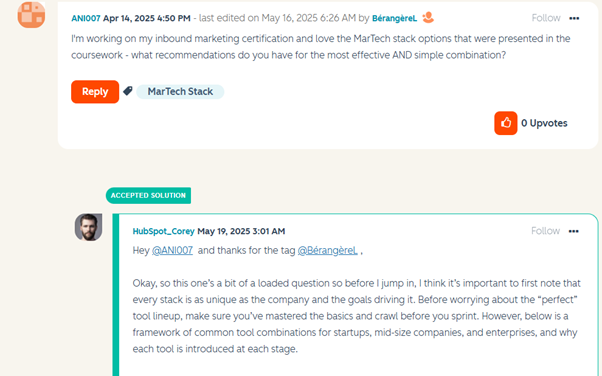
Mid-market businesses will begin integrating the following items:
- Data Enrichment: (i.e., Clearbit, ZoomInfo, etc.) Services for enriching lead and customer data quality.
- Sales Engagement: (i.e, Outreach, Salesloft, etc.) For synchronization of sales sequence management to HubSpot Workflows.
- Attribution and Business Intelligence: (i.e., Looker, Tableau, Power BI, etc.) For funnel analysis beyond native dashboards.
- Webinar and Event Tools: (i.e., Zoom, GoToWebinar, etc.) Integration of event tools for lead scoring.
Source: HubSpot Community
As organizations move to mid-market stacks, there is more emphasis on operational discipline and cross-system reporting.
HubSpot Tech Stacks for Enterprise
In enterprise organizations, HubSpot is most frequently paired with the following solutions:
- CDP/Data Warehouse: (i.e. Snowflake, BigQuery, Redshift), which feed identity and behavioral data to broader analytical tools.
- Data Orchestration Tools: (i.e., Census, Hightouch) – Reverse ETL platforms used to synchronize customer and engagement data across various systems.
- Privacy and Consent Platforms: Tools used at scale to manage user-level preferences.
- Advanced Attribution Engines: Multi-Touch Attribution Engines used to provide executive-level reporting.
Enterprise stacks place a greater focus on governance, scalability, and alignment across multiple departments.
ActiveCampaign Stacks for SMBs
ActiveCampaign’s technology integrates marketing automation, CRM, and basic customer experience tooling into a cohesive package that appeals to smaller organizations.
Most commonly paired with the following types of integrations:
- E-commerce Integrations: (i.e., Shopify, WooCommerce, etc.) – For behavior-based triggered campaigns.
- Landing Page Tools: Tools to build landing pages designed to capture leads and feed data into ActiveCampaign automations.
- Support Tools: Zendesk, Freshdesk, etc. – Typically used by companies to align across customer service.
- Basic Analytics: Google Analytics and tag manager tools for campaign performance tracking.
ActiveCampaign’s footprint of 251,991 live sites reflects its strong presence in SMB scenarios, where simplicity and price-performance are compelling factors.
ActiveCampaign Stacks for Mid-Market
As companies grow:
- Data enrichment and segmentation tools are added to refine audience profiles.
- Attribution Accessories help assess channel performance.
- Sales Engagement & Routing Tools begin to appear for more nuanced CRM workflows.
ActiveCampaign remains less common as a lead automation platform at enterprise scale, but it is used within subdivisions or business units within larger organizations.
Oracle Eloqua
Eloqua’s adoption footprint is smaller in raw detection counts, reflecting its positioning in enterprise environments focused on governance and depth rather than sheer volume.
Eloqua Stacks for Mid-Market
Eloqua becomes part of organizations where there is a critical need for a dependable, controlled data flow between systems:
- Deep Integration with CRM Platforms (Salesforce/Microsoft Dynamics CRM Integration): An example of this type of integration would be the Salesforce Marketing Cloud (Eloqua) and/or other similar products.
- Data Governance Tools: These tools are designed to ensure organizations remain compliant with privacy regulations.
- Advanced Analytics: BI products that serve executive reporting requirements.
- Automation Orchestration Tools: Middleware and integration layers that maintain synchronization across systems.
Eloqua Stacks for Enterprise
Enterprise Eloqua Stacks at the largest levels of scale:
- Centralized Identity Resolution/Centralized CDP Layers (Centralization of Customer Records): These are systems that combine all customer interaction points into one single record.
- Data Warehousing and Analytics (Snowflake/Azure Synapse): These technologies enable organizations to create enterprise reporting pipelines, which can then be utilized by the organization to create data-driven decisions from both historical and real-time data.
- Advanced Governance Layers/Centralized Consent Management: These are tools that enable organizations to maintain their user and customer preferences and comply with applicable legislation.
The combination of the above technologies demonstrates an organization’s focus on producing quality data and minimizing its risk.
Top Companion Tool Categories Across Platforms
Across platforms and stages, certain tool categories recur because they meet common operational needs.
| Category | Typical Companion Tools |
| CRM & Revenue Systems | Salesforce, Microsoft Dynamics |
| Data Enrichment & Identity | Clearbit, ZoomInfo |
| Attribution & Analytics | Power BI, Tableau |
| Sales Engagement | Outreach, Salesloft |
| Support & Service | Zendesk, Freshdesk |
| Webinar/Events | Zoom, GoToWebinar |
| Data Sync/ETL | Census, Hightouch, Stitch |
These categories reflect capabilities organizations seek beyond basic automation: data quality, sales pipeline clarity, and cross-team alignment.
SaaS vs. Services Dependency
In smaller organizations, stacks lean heavily on SaaS tools that offer multi-functionality without complex integration requirements. As companies grow, reliance on services — for setup, governance, and custom orchestration — increases markedly. Complex stacks demand not just technology but operational expertise.
Patterns and Risks as Stacks Scale
Across the small to medium-sized business to the enterprise growth trajectories, there are three distinct patterns:
1. Increased Level of Specialization in the Tools Used: Organizations focus on adding additional specialized tools to gain deeper insights and integrate marketing and revenue operations more closely.
2. Increased Complexity of Data Governance: What started as simple lead routing can quickly grow into cross-system identity management and compliance problems.
3. Growth of Operational Load Outpaces the Tools Available to Support that Load: Without governance structures being purposely established, technology stacks break into multiple silos containing data definitions that are in conflict.
Common risks encountered include:
- Duplication of data across systems
- Incomplete attribution models
- Insufficient monitoring of integrations
Stack Audit Dataset Template
To make this analysis actionable, the stack map is supported by a downloadable dataset built from publicly observable technology signals.
The Excel file is designed to help founders, CMOs, and RevOps leaders compare their marketing automation stacks to common coexistence patterns across SMB, mid-market, and enterprise environments. marketing-automation-stack-map-2026-download
What’s included in the file
Each row in the dataset captures a single observed stack relationship using the following fields:
- platform – The primary marketing automation platform in use (HubSpot, Eloqua, or ActiveCampaign)
- domain – The website where the technology combination was detected
- companion_tool – The additional tool observed alongside the primary platform
- category – Functional classification (CRM, enrichment, analytics, sales engagement, support, events, data/ETL)
- detected_on_date – The date the co-existence signal was observed
This structure allows teams to filter, segment, and audit stack composition by platform, category, or business stage.
How teams use this data
The CSV is most useful when applied as a baseline assessment tool:
- Stack audits: Identify gaps, redundancies, or over-concentration in specific categories
- Migration planning: Compare current tooling against common patterns at the next growth stage
- Vendor evaluation: Validate whether a proposed tool aligns with real-world co-existence patterns
- Governance reviews: Surface areas where ownership or data flow responsibility is unclear
Rather than relying on vendor diagrams or theoretical stack lists, this dataset reflects how platforms appear together in live environments.
A 30-Day Marketing Automation Roadmap
A 30-day automation roadmap provides a clear understanding of the steps a company must take to stabilize its marketing automation stack by rebuilding and revitalizing the organizational infrastructure following a period of growth, revealing gaps due to a lack of proper structure, data flow, or ownership.
While there may be interest in growing to a larger marketing automation stack during this time, the focus should be on building a solid foundation by ensuring clarity in each phase of the process before introducing complexity.
Week 1: Establish Clear Systems of Record
The first week focuses on defining where critical data is created, updated, and trusted. Many stack issues stem from multiple systems attempting to own the same information.
Lifecycle stages, lead sources, account data, and revenue fields often exist across multiple platforms, leading to silent conflicts and unreliable reporting.
During this phase, teams identify which system holds authority over each shared data point and document how updates are allowed. Field definitions are aligned so that marketing, sales, and leadership interpret data consistently.
By the end of the first week, there is a clear answer to a simple but essential question: which system is responsible for the truth?
Week 2: Bring Discipline to Data Movement
Once ownership is clear, attention shifts to how information moves between platforms. As stacks grow, direct integrations tend to multiply without coordination, creating fragile dependencies and duplicated syncs.
This phase involves mapping data flows across the stack and simplifying where possible. Data movement is adjusted to follow defined directions rather than circular paths.
Monitoring is introduced to surface failures quickly rather than keep them hidden. The objective is not speed, but reliability.
At the end of this stage, data travels intentionally, with fewer breakpoints and clearer visibility.
Week 3: Align Reporting and Attribution
With stable data foundations in place, reporting can again support decision-making. This week centers on alignment between marketing and sales, particularly around attribution and lifecycle progression.
Teams agree on what attribution should explain and avoid overengineering models too early. Lifecycle stages are standardized across platforms, ensuring consistent handoffs.
Shared dashboards are created using common logic, reducing the need for manual reconciliation. The outcome is a reporting layer that enables conversation and planning rather than debate.
Week 4 – Establish Governance
In the final week, the concern will be Sustainability. Without Governance, the best-designed stacks will begin to drift back into a level of inconsistency over time.
You will assign ownership for field changes, integration changes & automation logic. Data quality standards are defined, and privacy controls are reviewed to ensure consent and preference rules are applied consistently.
A regular review cadence is introduced so that stack changes are evaluated rather than silently accumulated. This phase turns short-term improvements into an operating rhythm.
How The Automation Strategy Group Supports Modern Marketing Stacks
The Automation Strategy Group works with growing SMEs, mid-market, and enterprise-level organizations to design, build, and maintain marketing automation stacks that effectively support real revenue-generating activities.
Our focus will be to ensure your automation systems efficiently combine the tools available to you (software platforms) and your data (customer information) with your processes (marketing, sales & customer service) to provide lead management, sales pipeline visibility, cross-team collaboration, and support for the successful execution of leads from initial contact to conversion.
This will involve stack audits, platform implementations, integrations, lifecycle designs, and continual stack optimization for applications such as HubSpot, Eloqua, and other related technologies.
We view the marketing automation stack as an operating system rather than just a group of applications.
Therefore, the Automation Strategy Group can remove friction across the various elements in your stack, help you achieve reliable data to better support your use of automation, and scale your automation while maintaining full control.
Final Thoughts
The marketing automation technology stack, as defined in 2026, is changing; more emphasis is being placed on understanding how tools work and interact across platforms, how data moves between platforms, and how teams manage the automation process over time than on choosing a marketing automation tool.
Understanding this will help organizations scale effectively, accurately measure performance over time, and respond more effectively as business needs change.
For leaders reviewing the effectiveness of their current stack, the focus will be less on deciding what tool to purchase and more on determining if their current stack is equipped to support their organization’s next stage of growth.